Author Archives: Craig

Official “Soft” Launch of The Energy Primer – Press Release!

FOR IMMEDIATE RELEASE

New Independent Energy Website Launches Free Tools to Compare Real-World Energy Costs

Southampton, MA — October 2026 — The Energy Primer (theenergyprimer.com), a self-funded, noncommercial educational website, has officially launched to provide consumers with clear, data-based information about energy efficiency, costs, and conservation.

Free from corporate sponsorships and advertising, the site features a growing collection of interactive energy calculators designed to help individuals make informed decisions about home heating, vehicles, appliances, and everyday energy use.

In an era of conflicting media reports and aggressive marketing of new energy technologies, The Energy Primer focuses on real-world performance, actual energy costs, and practical comparisons. Its goal is to bridge the gap between complicated technical information and the decisions consumers make about their homes, vehicles, and energy use.

“Most energy advice online either oversimplifies the science or hides a sales pitch,” says Craig Issod, founder of The Energy Primer, whose nearly five decades of experience in alternative energy, conservation, and consumer education inform the project. “Government sites may hold accurate data, but it’s not distilled or explained.”

Issod entered the alternative-energy field in 1978, initially working with wood and solar heating systems. His businesses eventually expanded into retail, wholesale, importing, and manufacturing. He later founded Hearth.com, one of the early large-scale consumer information websites devoted to home heating.

“True efficiency isn’t just about buying a new appliance; it’s about understanding the trade-offs,” Issod says. “The calculators give people a way to plug in their own costs and circumstances and get a clearer picture of the financial and environmental choices involved.”

The Energy Primer includes calculators and educational resources covering topics such as:

  • Home Heating Costs: Compare the delivered cost of heat from heat pumps, natural gas, propane, heating oil, electric resistance, wood, pellets, and other common heating sources using adjustable energy prices and real-world efficiency assumptions.
  • Vehicle Energy and Fuel Costs: Compare gasoline, hybrid, plug-in hybrid, and electric vehicles using factors such as fuel prices, electricity rates, MPG, charging costs, and overall energy efficiency.
  • Water Heating and Household Energy: Explore the operating costs and efficiency of heat-pump water heaters and other common household energy systems.
  • Energy Myths, FAQs, and Explainers: Short, accessible articles examining common claims about energy, efficiency, electrification, conservation, and emerging technologies.

The site is designed around a simple principle: give consumers enough information to understand the numbers and allow them to adjust those numbers to reflect their own circumstances.

The Energy Primer is free to use and carries no advertising or paid sponsorships. Its calculators, articles, formulas, and underlying assumptions are provided as an independent educational resource.

To use the calculators and explore the site, visit theenergyprimer.com.

About The Energy Primer

Founded in 2026, The Energy Primer is an independent, self-funded educational website focused on energy literacy, conservation, and practical consumer decision-making. It translates complex energy concepts into understandable articles, comparisons, and interactive calculators that consumers can use to evaluate their own energy choices.

Media Contact

Craig Issod
Email: energyprimer@protonmail.com
theenergyprimer.com
How to Read your Electric or Gas Bill – Simplified

Imagine if you pulled up to the pump and instead of $4.00 per gallon, there were two or three pages of information detailing what the costs of pumping, transporting, refining, taxes and other costs listed??? You’d be confused, right?

This is what your Electric and Gas bill are – and why so many people seem to get confused and upset when reading theirs. Since most of us do not have real choice in the matter, there are only two numbers that matter – and the most important number is simply one of them divided into the other!

The Numbers are:
The total you pay for the month.
The total in kWh (or therms if gas) that you used.

Do not look at all those other numbers! Here are two real world examples:
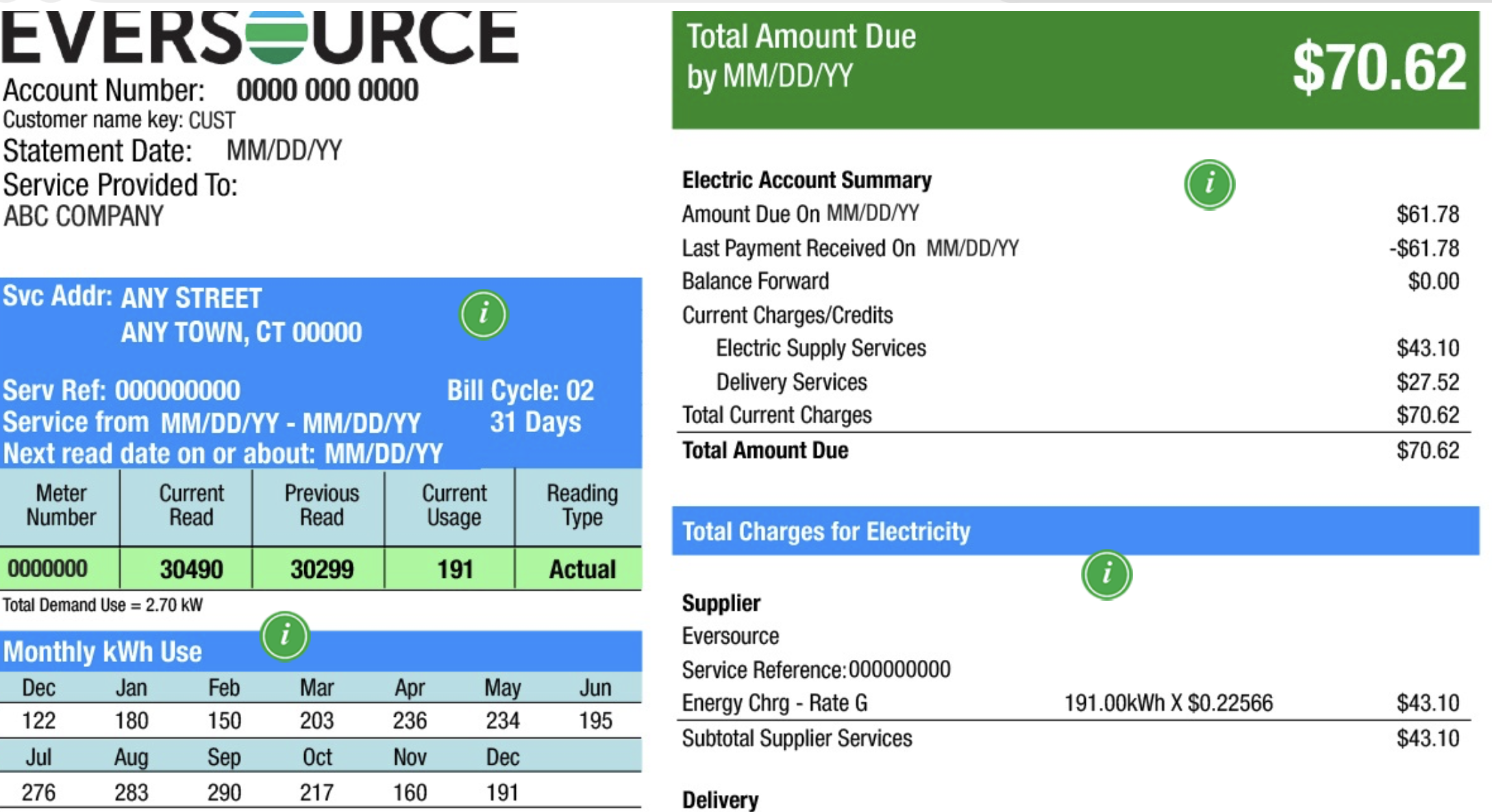
You used 191 kWh of electric and your bill was $70.62
70.62/191= you paid about 37 cents per kWh

When it comes to Natural gas, it works in a similar fashion, however the cost per “unit” is higher because gas is measured in a unit which has 30X more energy than electric. Note: “therm” or “ccc” are used interchangeably, both being about 100,000 BTU of energy

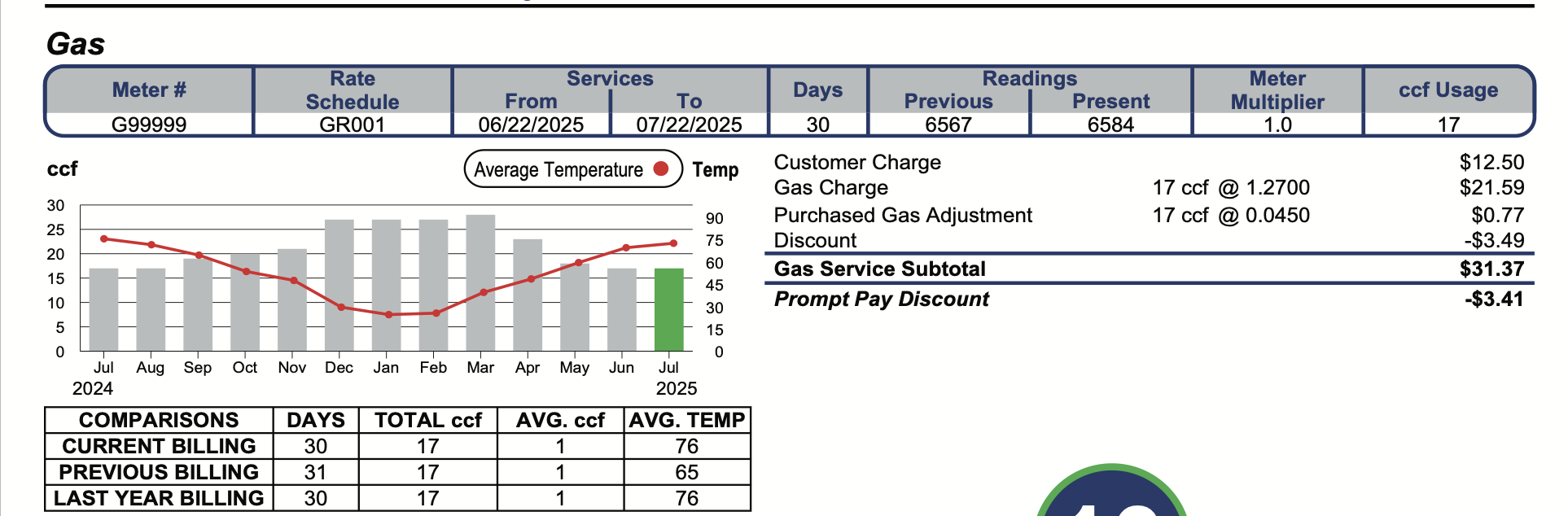
In the off-season bill sample we see below, the customer used 17 “units” (therms or ccf) of gas and the bill is $31.37
31.37/17=$1.85 per therm

Any information or discussion after the basic figures is either technical or political/economic. It doesn’t matter what the “name” of the individual charges are – all that matters is the total due divided by the units used.


Do Not Use AI for your Energy Questions!

The Bias AND Wrong answers are off-the-charts

The evolution of Machine Learning (AI) is an amazing thing – akin, in many ways, to the public availability of the Internet itself. However, in Energy related subjects I find it to be severly lacking – to the point where it might cost you a LOT of money if you listen to the “advice” being given.

Let’s start with the very basics. AI have no insider information of our Energy situation. Just as you might do, it goes looking around on other sites for information to use for an answer to your query. But, unlike the searches of old, it has an additional layer of bias – some would say extreme bias. AI is not a “honest broker”. It is programmed by corporations and people to reflect certain foundational information. As an obvious example, AI would never question Global Warming or Climate Change and will classify CO2 (what we and plants breathe) as a Pollutant. CO2 is a discussion in itself, a metric – a data point – and excess levels can have consequences, but it should not be looked at in the same way as carcenigenic poisons and small particulates, etc.

AI is very “national” in it’s logic. All of these things are programmed into it. Not only does it have it’s basis as determined by those who write it, it then gathers all the Media and Repetition of such – that reflect many of these biases, and adds that to the mix.

To put it bluntly, saving you money on your Energy bill is not one of the programmed biases. Our General Media (USA)…all added together….is NOT a common sense outlook on your specific situation.

This is very evident is the issue of Electrification – the conversion of most of our home and transportation energy away from multiple fuels (gas, oil, etc.) and into a single source – that being “the Grid” -and our Electric company! Make no mistake about it – this is very new! For decades many consumers have looked at having diverse fuels as a good thing! Independent minded homeowners often have wood burning stoves or a natural gas fireplace – something which will work when the the Grid does not!

So….why is this happening? Why the bias? Pretty simple – the tech brothers all live in a very temperate climate and heating a home is not first on their list! They also live in California, a state with the highest percentage of renewable energy – and so, in their case, electrification makes good sense! But when they tell a homeowner in New England to switch out their Gas Furnace to a heat pump – they might cost said homeowner an extra $500 a month for heating!

An expert like myself – can eventually get AI to give me the correct answer – but it’s quite difficult. I often have to go through 2 or 3 clarifications which no normal homeowner would ever do. Example…might go like this.

Me: Should I get a heat pump water heater
Google: They are extremely efficient!
Me: How much heat do they lose when on standby (I have a instant gas heater).
Google: It’s very little – negligible. Between tank and pipe losses, etc. it migth be 1.5 kWh in a day. Nothing much to be concerned about.
Me: I pay .34 a kWh – so that means $15 a month for nothing…not even for hot water, just for standby
Google: Yes, your price for electric changes the equation.

And it goes on. The conversation, if I left it to AI, would approve of me getting a hot water system which would cost me 4 to 5X as much per month as my gas one.

I really shouldn’t have to say more on ths subject. But for the more technically minded and those who can’t imagine “why” this is the case, I can only guess in this manner. The governments and utilities all predicted a decade back that our Electric would, by now, really be far along in terms of being generated by Renewables (Solar PV and Wind, mostly…along with Hydro and some Nuclear). They didn’t imagine that we’d STILL be less than 20% renewables in 2026-2027. As a result, most all Media and Planning was based on cheap and renewable Electricity. For much of the nation, this is NOT the case. And yet – as far as AI goes, the Big Brain thinks as it is programmed.

Do your homework. But seek the truth. Do not rely on AI to speak the truth about Energy Matters – Google or ChatGPT are not going to pay your energy bills!

I’d welcome comments and rebuttals to this – however, I have saved all my conversations with Google and other AI Agents which prove the bias – so there is really not a “leg to stand on” when it comes to the built-in bias of current AI consumer chatbots.

Will a Plug-In Hybrid save Money over a Regular Hybrid?

Or, How I lost $1,000 plus per year by plugging my car in!

Note: this was a question from a buyer considering the same car I am currently purchasing – A Rav4, 2026, which is available in a Plug-in Version. Will they – or you – save $$ by charging a PHEV (Plug in Hybrid) at Home?

Here are some calcs.
I’m going to do it as if it were me.
I have expensive electric (so do many!), however you will see that the cost of Electric is not the deciding factor.

Plug-in hybrid vs. regular hybrid: cost comparison

Would the plug-in cost more to own for one year? Change a few figures to see.

Regular hybrid: gas cost per year
Plug-in hybrid: gas and electricity cost per year
5% annual Interest cost of extra money spent
Extra insurance cost per year
Assumptions and explanation from The Energy Primer

Regular hybrid: 42 MPG. Plug-in hybrid on gasoline: 40 MPG. Plug-in electric driving: 3.0 miles per kWh measured at the outlet, including charging losses. Additional plug-in insurance: $200 per year. These are illustrative figures, broadly based on a compact SUV; actual models and driving conditions vary.

The extra purchase price is used to estimate one year's cost of tying up that money at 5%. For example, 5% of $8,000 is $400 per year. The $8,000 itself is not added again to the annual result. This rate is an illustration, not a predicted loan rate or investment return.

*Some states or localities assess an annual vehicle tax or fee based on value. The checkbox estimates the additional cost of owning the higher-priced plug-in at $150 a year, not the total tax paid on the vehicle.

The comparison does not estimate resale value, actual financing costs or investment returns, maintenance differences, rebates, or changes in future fuel prices. The electric share represents miles driven using purchased electricity; it is not the vehicle's MPGe rating.

My own Situation…….below – which I calculated before I built the calculator.
Facts at Hand: The Plug-In version, including a basic charger at home (very basic) and extra Sales Tax, etc. will cost approximately $10,000 more than a lower Trim Level Hybrid.
1. Fact #1: Cost of Money – that same 10K earns 5% ($500 a year) in CD’s or 10% ($1000 per year in the Stock Market).
2. Fact #2: The Insurance Cost of the more expensive Rav4 will add about $200 a year to my insurance bill.
3. Fact #3: In MA, we have personal property taxes paid each year. It will cost me $200 or more per year more – the first year and also cost quite a bit more for a few years.
4. The Plug-In Model actually gets 2-3 MPG less than the Gasoline Version, so my car will cost more when running on gasoline.
————–
In total, the extra costs will be, in addition to the “sunk” money for the more expensive vehicle, in the realm of $1500 extra per year. When I sell the car used in 8-10 years I am very unlikely to get much of that 8K (extra car cost beside charger) back.

Now- Let’s see how much each mile driven on the gas – and electric – cost me.
https://theenergyprimer.com/compare-the-costs-per-mile-of-usa-passenger-vehicles-gas-or-electric/

Plugging it in at home (.33 a kWh) will cost me about .11 a mile driven. Buying gasoline at $4 (average over the years…it will probably be less!) will cost me 9.5 cents a mile. So I will LOSE Money on the plug in – beside all the extra money!

However, let’s say you pay 1/2 as much for Electric as I do and you drive 10K miles a year – 50% of them electric! You would then save $250. per year in fuel.

OK, so you get your electric FREE. You pay zero for the 5,000 miles, thereby saving $500. Congratulations- you lost only $800-$1000.

This does not include the lesser MPG of the Plug-in Model. It does not include any benefit you might feel if your Electric Grid is majority renewable (US Grid is less than 20% PV and Wind).

Also, it does not figure on future vehicles with Plug-in being available at a small or no up charge. If that were the case, it might provide a good “fuel insurance policy”, especially if a homeowner installed PV Solar on their own home.

In summary, however, the amounts of money being saved – in general – are not enough to offset the much higher costs of the Plug-In car being asked about (2026 Rav4 by Toyota).

Some of the Beginnings of the Modern Alternative Energy – and other related issues – from a Hollow in Vermont

How a bunch of Hippies combined with (and often the same as) highly educated Ivy League graduates just may have changed the world.

This is a story – in writing and audio – about the so-called “Prickly Mountain Gang” from the 1970’s.

From the article:
“Prickly Mountain became a caldron of entrepreneurial stew. Suddenly, everyone had a business. Norton, along with other Prickly residents Andy Palmer, Chris McCarthy and Michael Goldfinger, started a furniture company called Union Woodworks. They leased space in the old Bibbin Mill, now co-owned by Sellers. Others soon followed: Randy Taplin was already established as a furniture maker; his wife, Nancy, was a working artist; Serena Fox started a graphic design business; Pierre Moffroid started importing tankless water heaters; Mac Rood and Rob Bass started exploring the manufacture and sale of composting toilets. Sellers also looked to be employed. He was hired at Goddard College in Plainfield to teach a class in design and building. One of his students, Don Mayer, was interested in bringing back the windmills that years earlier had been a common source of renewable energy on farms in the Midwest. Lessons of the past; solutions for the future. “Sure,” Sellers told him. “We can make that happen.” Before long Mayer, with Sellers, founded the North Wind Power company. And then two others, Duncan Syme and Richard Travers, started woodstove companies. It wasn’t long before many of these businesses and enterprises began cross-pollinating with the ideas and skills of other residents of Prickly Mountain. A wind turbine soon was constructed at Dimetrodon. (“The worst wind power site ever!” says Norton ruefully.) The commonalities soon led to a unique blend of practical skills and unbridled creativity.”

One might even say I, with a 40+ year career in Alt Energy and Tech, was directly influenced by this “gang”.

THE ELECTRIFICATION CONUNDRUM

(Opinion/Editorial)

Electrification may be the right destination but are we doing it in the wrong order?

Electrification has become one of the principal answers to climate change in the United States. Replace your gas furnace with a heat pump. Replace your gas car with an EV (Electric Vehicle). Replace the kitchen range with an electric or induction model.

The intentions are good. In many cases the efficiency is higher. But are we putting the cart before the horse?

Consider where I live – Massachusetts. Our state is using substantial incentives to encourage homeowners to replace oil and gas heating systems with electric heat pumps – these “rebates” and grants are paid for in ALL electric bills. At the same time, Massachusetts has electric prices among the highest in the country. A 2024 Harvard study estimated that, at the electric and fuel prices then in effect, about half of Massachusetts households and almost ALL heating with natural gas would experience higher annual heating costs after switching to a heat pump.

Heat pumps themselves are not the problem. They are remarkable machines that can deliver two or three units of heat for each unit of electricity they consume. But efficiency and cost are not the same thing. A highly efficient appliance running on very expensive electricity can still cost more to operate than the supposedly less-efficient system it replaced. Our comparison calculator will illustrate this for you.

This raises a fair question: Why were homeowners pushed toward electrification before the underlying economics were put in place?

CLEAN ELECTRICITY FIRST

There is also the matter of where the electricity comes from.

In 2025, New Englands power plants generated about 13% of their electricity from renewables and another 6% from hydroelectric power. Natural gas is, by far, the largest fuel – in some states and regions providing 80% of generation.
The basic picture is clear: our regional grid is less than 20% renewable, similar to the USA National Figure.

Electrification can still reduce emissions, especially when an efficient heat pump replaces oil heat or an EV replaces an inefficient gasoline vehicle. But the benefit is not “electric equals clean” OR “Electric equals cheaper”.
An electric appliance or vehicle is only as clean and economical as the system supplying its electricity.

Perhaps we should put much more of our money and effort into renewable generation, transmission, storage, and grid modernization first. Then, as electricity becomes both cleaner and less expensive, accelerate the push toward electrification.

That would be an intelligent sequence rather than an ideological one.

THE EV PRICE LOTTERY

Electric vehicles present another version of the same problem.

An EV owner with inexpensive overnight charging may pay only a few cents per kilowatt-hour. Another owner may pay more than 30 cents at home, while public fast charging commonly costs around 50 cents per kilowatt-hour. In much of the country, this determines whether an EV is exceptionally inexpensive to operate or offers little fuel-cost advantage over an efficient hybrid.

Imagine if gasoline cost $3 per gallon in one state and $12 or $15 in another. We would consider that an enormous national problem. Yet we appear willing to build transportation policy around electricity that can vary almost as dramatically depending on where and when someone charges.

There is another difference. Most consumers have multiple gasoline stations competing for their business. A homeowner normally has one electric utility delivering power. Alternative suppliers may exist in some states, but the wires, delivery charges, and much of the bill remain under monopoly control.

Electric rates can occasionally decline, especially when fuel costs or special charges change. Over the long term, however, homeowners have good reason to expect that utility bills will rise as generation, transmission, distribution, storm resilience, and grid improvements are added to the system.

That uncertainty matters when government is asking families to make major investments in electric heating and transportation.

ELECTRIFICATION STILL MAKES SENSE FOR SOME

None of this is an argument against electrification – entire countries have moved successfully to Electrification with 100% renewables, in the process cleaning up their air and environment greatly. However, the USA is a massive land mass with a large population and legacy infrastructure. We can’t, at will, change to renewable and reasonably priced grid – doing so will take decades.

Some uses make sense now. An induction or electric range uses relatively little energy compared with heating a house or powering a car. It also avoids combustion pollutants inside the home. Even in a high-electricity-cost state, the difference in annual cooking cost is unlikely to determine a household budget.

A heat pump may be an excellent choice for someone replacing electric resistance heat, oil heat or living where electricity is inexpensive. An EV can be a great financial and environmental choice for someone with affordable home charging. The calculation simply does not come out the same for every household or every part of the country. Certain states and regions, California being the largest example, have substantial renewables to fuel your EV or Heat Pump.

That is precisely why one-size-fits-all electrification policies deserve more scrutiny.

PUT THE FOUNDATION UNDER THE HOUSE

The solution is not to retreat to fossil fuels. It is to build the foundation that widespread electrification requires.

The United States needs something approaching a Manhattan Project for clean electricity: vastly more renewable generation, storage, transmission capacity, and a modern grid capable of carrying the additional load from vehicles and buildings.

We also need regulatory policies that make electricity prices more stable and that allow ordinary consumers to benefit as renewable generation becomes less expensive. Otherwise, lower generation costs can be swallowed by rising delivery charges and grid expenses before homeowners ever see them.

Electrification is an important part of our energy future. But paying people to switch to a system that may cost them considerably more before making that system cleaner, more affordable, and more dependable is not sound energy policy.

Build the clean electrical system first. Make its benefits visible in consumers bills. Then the public will not need to be pushed so hard toward electrification.

They will choose it themselves.

SOURCES

Harvard Kennedy School, Heat Pump Adoption Not Cost-Effective for Majority of MA Households, Says New Study:
https://www.belfercenter.org/belfer-news/heat-pump-adoption-not-cost-effective-majority-ma-households-says-new-study

ISO New England, New England Power Grid Regional Profile:
https://www.iso-ne.com/static-assets/documents/100010/new-england-power-grid-regional-profile.pdf

Commonwealth of Massachusetts, Improving Interconnection to the Electric Grid:
https://www.mass.gov/info-details/improving-interconnection-to-the-electric-grid

Calculators – will be Central to The Energy Primer

In an attempt to simplify decision making and educate, we will be posting many Energy and Efficiency Calculators. Since our Menus and Site Navigation are not yet finished, this post will temporarily keep track of them until we clean things up.

NEW – Compare the cost of all Home Heating Fuels.


Heat Pump Vs. Natural Gas for Cold Climates in the USA.

Should I Fly or Should I drive? The “MPG” of Air vs. Car Travel.

Compare Cost per Mile of Gas Passenger Vehicles vs. Electric Vehicles.

The real TOTAL Efficiency of Gas, Hybrid and Electric Cars

Does AI Confirm what Energy Primer says about Efficiency

This is a more complicated question than it first seems. AI doesn’t “think” things out – it goes and grabs a figure from Reddit, Facebook or Quora & quotes it. However, if the user prompts AI to research the topic – like “using sources like DOE and other engineering data, what is the Natural Gas powered grid to road effiiciency of an Electric Vehicle?” , you will get a more accurate answer.

As dad might say “Ask a Stupid Question, get a Stupid Answer” – it’s interesting that Media, the Public and therefore AI seems always biased in terms of the upsides. That is, it will easily make a mistake by saying “An EV is 40 to 50% (or even 60%) efficient well-to-wheels, but never make the same error on the downside, which would have to be “EVs are 12-18% efficient” to match the distance from the proper figures. I thought it might be instructive to give two examples of AI responses when it is properly questioned.

Example #1:
(AI says) “When accounting for real-world U.S. grid averages, transmission, charging losses, and vehicle operation, the true well-to-wheel efficiency of an electric vehicle powered by natural gas is 23% to 29%. Idealized engineering specifications that rely on best-case laboratory assumptions overstate efficiency, whereas factoring in operational averages properly brings the total below 30%”
(my notes: This one is very accurate– note it reflect our figures as Nat Gas Grid Example).

Example #2 – Chat GPT consistently reported number vastly higher – and used pages of calculation to “prove” itself.
(AI) “So roughly 38% well-to-wheels efficiency under that particular assumption.”
is an example of initial output. It even declared that Pessimistic! In another interesting slant, it tried to compare EV’s to Gasoline cars even though this was never mentioned or asked about. That’s a bias – and, of course, it was off on the upside with ICE vehicles also.
(AI)” The answer is approximately 50–60% WTW for a reasonable modern-grid calculation” is yet another of the wrong answers it returned.

So the question is why? The reasons are simple. AI doesn’t care about truth or accuracy at all. It will spit out wild numbers and back them up with math that isn’t needed nor relevant. It even admitted this:
“using actual U.S. average heat rates and losses, rather than the usual marketing-style” – WHAT? Of course, AI is going to reflect everything we do in the USA – and everything is marketed. It also states:
(AI) “The biggest problem is that people routinely quote the most favorable efficiency number from each stage without maintaining a consistent system boundary.“

In other words, people like PR and BS, if I might be blunt.

ChatGPT will eventually, but only if sources (like the Department of Energy and the Manufacturers of the Gas Turbine units, etc. are pointed to, give a number closer to reality:
“So is there an “upward bias”?

(AI)”I think there is a very real methodological bias, although I wouldn’t necessarily call it intentional“. (that is ChatGDP talking).
and, so – finally, ChatGPT can come to reality like this:

“If we’re asking the question you actually intended:

(AI)“Starting with the chemical energy in natural gas/coal, how much ultimately becomes useful mechanical energy at the wheels of a real-world EV operating on the U.S. grid?”
(AI) “I’d use ~28–31% as a reasonable engineering estimate“

(AI)”with something like ~30% as the central figure.”
(my comment = Close enough – but it takes a LOT to get the Chatbot to address the actual question).


New: Should I Fly or Should I drive Page Live!

Flying can actually be more green than driving – especially if the load is light (1-2 people) and the distance is great.

Our new calculator is at:
https://theenergyprimer.com/should-i-drive-or-should-i-fly-which-is-more-efficient/

FAQ
Q: Why only up to 1,500 Miles
A: This covers most Flights where folks might consider driving as an alternative. Also, longer driving distances start really adding up in terms of costs for food and hotels and in “lost” days. A

Q: What about my EV? Aren’t I getting almost free Miles and using Renewables?
A: Sadly, not in the USA where only 20% of our Grid is Renewable. Also, as you can see in our other articles and calculators, an EV is roughly equivalent to a decent Hybrid in overall efficiency when charging from the US Electric Grid – so choose the higher MPG – perhals 45 would be safe. Note: this is NOT an exercise in cost. But you can use our upcoming “cost per mile” calculator to compare $$.

Q: What about all the extras like Airport Parking, transport to the airport and back, etc. ?|
A. Yes, both flying and driving have “extras” in cost and energy use attached to them, however for simplicity we will assume they are similar for both transport types (more Hotels and Food with driving, more Paid parking and ground transport with flying).

Q: Are you pro-Aviation? I always thought Airliners were terrible in terms of “green”.
A. This is exactly the reason we did this calculator! Modern Air Travel, with the improved airliner design (Example, Airbus 220) get as much as 110+ MPG per seat! In fact, using the average car load for the USA (1.5 persons per trip), newer Airliners win the efficiency contest in most comparisons.

Q: Hmmm….I never really thought about it that way….
A. That is the goal of this site! To make us THINK about our choices. In fact, here is another interesting mind experiment. If we had to set up transport for distances over 500 miles – not only would Airliners be more efficient in the simple transport, but no infrastructure has to be built between the two points! So if we were starting today we could, in theory, save trillions of dollars and vast amounts of resources by not having the vast ribbons of concrete and blacktop and the services needed to keep our cars and us going. It’s similar to the Mobile Phone revolution – countries that skipped the landline ended up not having to wire every building in their state or nation! Newer nations and newly developed areas would be very smart to limit car infrastructure in favor of Electric Trains and Airliners – thereby preserving much more of the natural landscape.